
Deploy ↗
Personal Intelligence
An AI that understands your practice the way a long-serving employee would — your priorities, your language, your standards.
Stop using AI. Start deploying it.
You hold files that belong to other people, so the one tool everyone says will fix this is the one you are not allowed to touch — and doing nothing felt like the safe answer. This is the other way: an AI that runs on hardware you control, so your clients’ files stay where you put them, the chasing happens without you, and when someone asks what happened to a file, you have the record to show them.
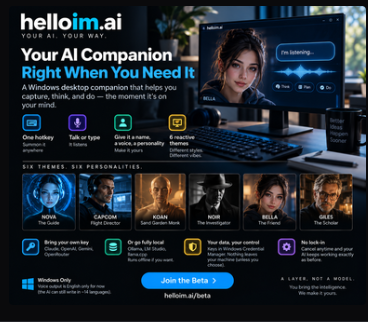
Just shipped · helloim.ai
The desktop app behind helloim.ai is free, and as of today the code that runs on your machine is public on GitHub. Not a privacy promise you take on faith — one you can read, line by line.
/ THE SHIFT
Installed on a machine in your office, built around how your firm already works.
It learns your matters, your clients, your language and the deadlines that don’t move.
Wired into the tools and files you already have, in place. Nothing gets copied out to a stranger.
The chasing, the follow-ups and the Monday admin happen without you opening anything.
It keeps adjusting as your caseload and your rules change.
/ WHAT I BUILD
An AI that understands your practice the way a long-serving employee would — your priorities, your language, your standards.
Everything it learns about your matters stays with it — clients, deadlines, promises and the details you'd otherwise repeat.
The recurring work — chasing records, drafting follow-ups, confirmations — runs on its own and reaches you only when it needs you.
/ THE DIFFERENCE
The model is not what protects your clients’ files. The contract is — and most of these companies sell you more than one contract. Which one you are on was decided by a document, not by the model, and a privacy toggle protects you right up until somebody in your office clicks it back.
Consumer account
Decided bya setting
Four of those train on what you type by default. One is off unless you go and switch it on. A subset of one of them is read by people.
Business contract
Decided bywhat you signed
Two of those are the same companies as the row above. All five state plainly, in their own terms, that a business tier is not trained on.
And two will not say either way
One API's terms contain no clause about training in either direction; one enterprise page is a 404. On a question about custody, silence is an answer.
Your own hardware
Decided bynothing — there is no counterparty
Three of those five carry a licence catch worth reading. Downloadable and open source are not the same word.
Where a company is based governs its service, not weights running on a machine you own. A vendor's privacy policy applies to its servers — not to a copy of the weights on your card, which never contacts them. That is the difference between downloading a model and opening an account, and it is the reason this row exists.
Where each one comes from
Llama 4 Meta, United States · Hermes 4 Nous Research, United States · Mistral France · Qwen 3 Alibaba, China · DeepSeek China
A blue name appears in more than one row — the same company selling you more than one of these arrangements, on different paper. Which one you are on was never a question about the model.
The model never changed. The paper did.
Read off each vendor's own terms on 7 August 2026. If that date is old, treat this as old.
All ten, read against their own terms — checked, dated and linked →
/ YOUR AI, DEPLOYED
Every deployment starts with how your firm actually works, not a template. What you get is one system, tuned to your matters and your workflows, running quietly in the background on hardware you control.
/ INSIDE THE DEPLOYMENT
The eleven-at-night question gets a real answer instead of a voicemail.
The records nobody chased and the acknowledgement nobody sent, drafted and out the door.
Deadlines, promises, who is holding what — held once, not re-explained.
The matters that need you come to you. The rest is handled without you seeing it.
Confirmations, reminders, the recall list, the Monday admin. They stop needing you.
A record of what went in and what was asked, timestamped and fingerprinted per file.
/ HOW IT WORKS
From the first conversation to something live is about a month. Here is what that month is.
/ HOW WE ENGAGE
Nobody is asked to commit to the whole thing sight unseen. You pay a real but small amount to be looked at properly; that tells you what’s worth building and what it costs; then you decide.
$3,500, credited toward your build. Paid, fixed.
I look at what you actually have — the machines, the files, who touches what — and hand you three things: a map of the work worth handing over, an architecture recommendation, and a scoped price to build it. Yours to keep and act on, with me or without me. If you go ahead, every dollar of it comes off the build.
Scoped from the assessment, live in about a month.
We build the first workflow the assessment found — one thing, done properly, running on hardware you control. Priced from the assessment, never as a flat guess, because the price should fit the work rather than the other way round.
A monthly retainer, with a defined envelope.
Once it’s live, I keep it running: monitoring, keeping up with the models and tools underneath it, and a set block of improvement work each month. It runs on your own key, so the usage bill is yours and the number doesn’t creep. Month to month — leave when it stops earning its place.
I will not quote the build before I have costed it. The assessment is where that number comes from — a figure given before the arithmetic is a guess, and a guess becomes the contract.
/ WHAT ACTUALLY RUNS
No case study, no testimonial — I’m not going to invent one. Instead, everything I do is written out at Learn: the operating system, the models, the hardware it takes, how it’s tested and what it costs to run. Free, no signup to read. Written well enough that you could hand it to whoever looks after your computers and build it yourself — and if you do, you owe me nothing.
Every change is reviewed by someone who didn’t build it, before it reaches you.
Logins are tried with the wrong password first, so a stranger isn’t the one who finds the gap.
The recurring work runs on its own schedule and reports only when there’s something worth reading.
When something is found broken, the fix comes with the report — not a list to get to later.
Twenty specialists. One job and one refusal each.
[ FOLLOW THE BUILD ]
The blog gets added to — new posts, corrections when something here stops being true, and the occasional write-up of what broke and what it took to fix. If you want to know when that happens, leave an email address.
The email box for this lives on the interactive copy of this page, which runs on its own server rather than here.
Prefer to talk instead? Ask for a fifteen-minute call →
/ MEET MARK
Twenty years in infrastructure before any of this — the kind of work where something either runs or it doesn't. I build personal AI deployments for the same reason: not because AI is interesting, but because the good version of it should feel like infrastructure — something that just runs, that you stop thinking about, that's actually yours.
Twenty years of that is twenty years of deciding where files actually sit and who is allowed to reach them. That is the half almost nobody selling AI has, and it’s the half that decides whether your clients’ files stay where you put them.
That background changes what I build. I am not shipping a demo and calling it transformation. I am shipping something that has to survive a Tuesday at 3am with nobody watching it, with a log you can read afterwards and a defined answer for what happens when it is wrong.
If you have work that repeats every week, follows rules you could explain in ten minutes, and nobody enjoys doing — that is the whole conversation. Everything else is detail.
Infrastructure
Networks, uptime, the things that must not fall over.
Engineering
Model-agnostic systems, structured outputs, real integrations.
Deployment
Discovery to live in about a month, then continuous.
Mark Dalton — The Woodlands, Texas
[ OPERATOR ]
Mark Dalton
/ QUESTIONS PEOPLE ACTUALLY ASK
No. A chat window is one possible surface. The deployment is a system: memory of your work, connections to your real tools, and automation that runs on a schedule whether or not anyone is chatting with it.
Whichever suits the job, and it is designed to be swapped. Model choice is a configuration value, not an architecture. That includes open-weight models running on hardware you own where the custody requirements call for it.
The point is that your clients’ files run on hardware you control. Usually that’s a machine in your office. Where a firm genuinely can’t host its own, it can be a private space that is yours alone — your own tenancy, your own key, nobody else’s work on it. What doesn’t happen is your clients’ files going into a shared public service.
No. That belongs to your regulator, your insurer or your lawyer, and it’s about your firm, not my software. What I can tell you is where the data sits, who can reach it, and what’s recorded when they do — which is what those people are going to ask you anyway.
Good. The system wires into them. Replacing software that works is the fastest way to make a project fail, so I do not start there.
I’ll tell you where your files are going now, what’s worth building first, and what it would cost. If the honest answer is that you’re fine as you are, that’s the answer you’ll get.
Tell me what your firm does